Pool Filter Pressure Gauge Not Working?
If your pool filter pressure gauge is not working, do not assume the filter is safe or that its pressure is normal. A needle that stays at zero, freezes at one reading, or fails to return to its resting position may indicate a faulty gauge or a blocked gauge port. But low water flow, a pump that has lost prime, and a variable-speed pump running slowly can also explain a very low reading. Start by comparing the gauge with actual circulation, then follow the filter manufacturer’s safety procedure before anyone removes a fitting.
Important safety rule: A filter tank can retain hazardous pressure even when its gauge says zero. Never loosen the gauge, air-relief assembly, clamp, lid, or other fittings while the system may be pressurized. If you cannot independently confirm safe depressurization using your exact equipment manual, stop and call a qualified pool technician.
Quick diagnosis: what the pressure gauge is telling you
| What you see | Possible explanation | Safer first check |
|---|---|---|
| Needle stuck above zero after shutdown | Damaged or stuck gauge; residual pressure is also possible | Do not loosen anything. Follow the filter’s shutdown and air-relief procedure; request service if pressure state is uncertain. |
| Gauge reads zero while pump runs; return flow is weak | Pump is not primed, suction restriction, closed valve, or another flow issue | Check pump operation and accessible skimmer water level; use the pump priming troubleshooting guide. |
| Gauge reads zero or very low; returns seem normal | Low pump speed, gauge problem, or restricted gauge port | Compare at the same pump RPM as your normal clean-filter baseline; do not assume the gauge is defective yet. |
| Needle does not move between normal operating conditions | Stuck gauge or obstructed pressure-sensing passage | Arrange inspection after safe isolation and depressurization. |
| Gauge is cracked, leaking, heavily corroded, or fogged | Physical deterioration or failed seal | Switch equipment off and arrange correct replacement; do not operate damaged pressurized equipment. |
The pressure gauge measures pressure at its mounting point, not total water flow and not how clean the pool water is. A reading such as 15 psi (about 103 kPa) cannot be labeled good or bad without the filter model, pump speed, plumbing layout, and a clean-filter baseline. For an explanation of genuinely high readings, see the separate high-pressure guide once it is published; this page focuses on whether the instrument itself is trustworthy.
Where is the pool filter pressure gauge?
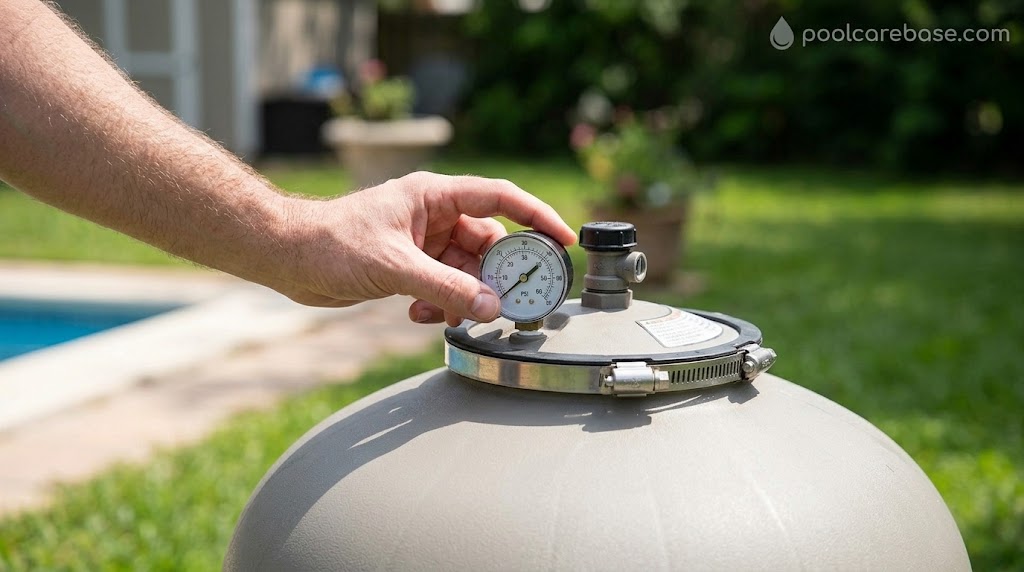
On many residential sand filters, the gauge is attached near the multiport valve; on some cartridge or diatomaceous earth (DE) filters it is mounted in or next to the manual air-relief assembly. The arrangement varies by manufacturer and model. Look for a round dial labeled psi, often with a colored clean-filter marker. Do not confuse it with the pump’s clear strainer lid or a plumbing valve.
Step 1: check whether the pump is actually circulating water
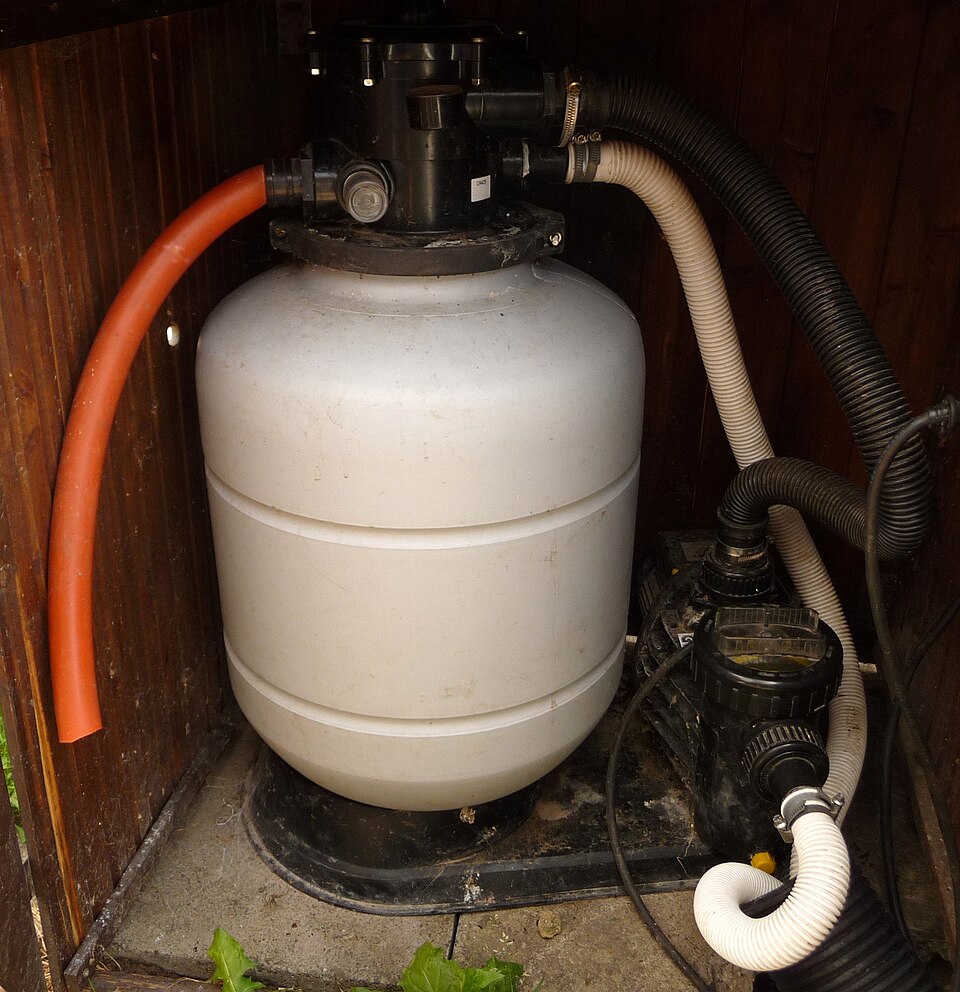
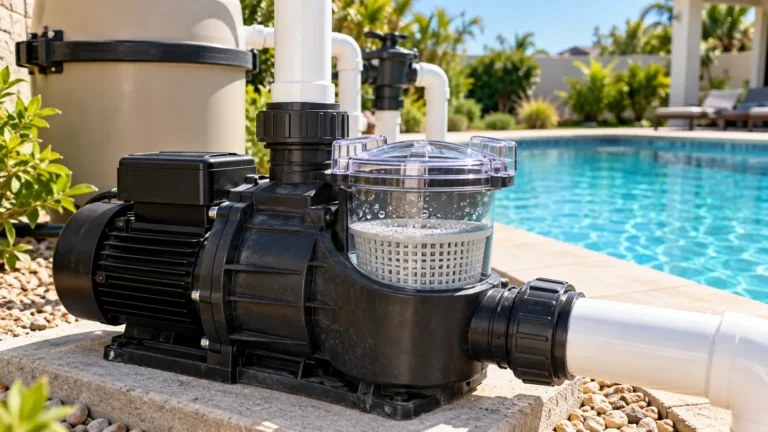
Before blaming the dial, look at the system from a safe position without opening any pressurized component. Is the pump running at its expected programmed speed? Is the pool water level adequate for the skimmer? Is there visible return movement at the pool jets? Does the pump strainer basket appear to stay filled with water? These clues help separate a gauge problem from a real hydraulic problem.
- No or weak return flow: suspect a pump, priming, valve, basket, or suction-side problem before the gauge. Avoid running a pump dry. Follow your equipment manual and the pool pump not priming checklist.
- Normal-looking return flow: the system may be circulating even if the gauge is stuck, but visual flow alone does not prove safe pressure or correct filtration.
- Variable-speed pump: a lower RPM can produce much lower pressure than the same system at high RPM. Compare readings at the same RPM and valve settings.
- Unexpected noises, leaks, or bulging equipment: turn off power and request professional service; do not try to force the system to run to test the gauge.
Step 2: observe the needle without removing anything
While standing clear of the filter, note the gauge reading at its usual operating speed. Shut the pump down using the manufacturer-recommended method, then observe the needle without touching fittings. A healthy gauge often returns to its zero reference after the system has been properly depressurized. However, a gauge that says zero does not confirm zero pressure; a blocked or broken gauge can lie. Conversely, a nonzero reading after shutdown may indicate trapped pressure or a stuck instrument.
If the needle remains at exactly the same number despite normal changes in operating state, it may be stuck. A gentle tap on the outside of the dial may reveal a sticking needle, but it does not repair the instrument or verify system safety. Do not strike the filter housing or use a tool to force the needle.
Step 3: distinguish a bad gauge from a blocked port
The narrow passage connecting the filter to the gauge can become restricted by debris, mineral deposits, or filter material. If that passage is blocked, the gauge may stay at zero or respond slowly even when water is moving through the filter. A new gauge may show the same symptom if the port remains obstructed.
This is a service decision, not an invitation to probe the opening. Inspection of the gauge port or air-relief assembly requires the exact filter manual, electrical isolation, verified depressurization, and appropriate tools. Do not insert wire or a screwdriver into a connected, possibly pressurized filter. If the gauge and manual air-relief share an assembly, improper removal can create a serious separation hazard.
What does a working pressure gauge look like?
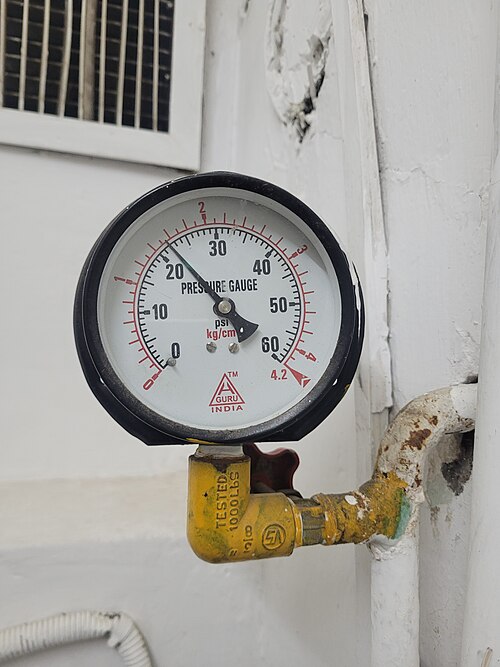
A typical dial shows pressure in pounds per square inch (psi), sometimes alongside bar or kg/cm². One psi is approximately 6.9 kilopascals (kPa). The gauge in the photo is a general-purpose example: do not use its indicated value as a target for a pool filter. Your target is the pressure recorded when your clean filter operates under its normal conditions.
When should you replace the pressure gauge?
Replacement is usually appropriate when the gauge is visibly cracked or leaking, its needle is damaged or does not respond to verified pressure changes, or its readings remain unreliable after a qualified inspection confirms the port is clear and circulation is normal. If you are unsure whether the reading is incorrect or the filter is retaining pressure, have a pool professional assess the system first.
Buy a replacement compatible with the exact filter and air-relief assembly. Verify the manufacturer’s part number or approved specification, mounting orientation, pressure range, thread type, and seal requirements. Do not assume all residential gauges use the same fitting or that a universal gauge is automatically safe. A gauge marked with a broad range is not proof it matches your equipment.
Safe replacement overview (follow your exact filter manual)
Some manufacturers permit a straightforward gauge replacement, while others restrict service of the air-relief assembly to qualified professionals. The sequence below is an overview, not a substitute for the model-specific instructions:
- Identify the filter: record its brand, model, and the gauge or air-relief part number; obtain the official manual.
- Isolate electrical power: stop the pump and disable automatic restart at the breaker or approved disconnect; do not rely only on a timer.
- Relieve trapped pressure: use the manufacturer’s manual air-relief procedure while standing clear. Because the existing gauge may be defective, do not use its zero reading as the sole confirmation that the tank is depressurized.
- Stop if uncertain: if the relief valve is damaged, obstructed, or the tank cannot be safely confirmed depressurized, leave all fittings untouched and call a professional.
- Install only approved parts: where the manual explicitly permits owner replacement, use the specified sealing method and tightening instructions. Avoid overtightening plastic parts or using improvised adapters.
- Restart exactly as instructed: confirm the assembly is secure, valves are correctly positioned, and air is vented according to the manual. Stand clear during startup; shut down immediately if leaks or abnormal behavior occur.
For example, the official Pentair Clean & Clear Plus installation guide describes a specific gauge-to-air-relief connection, calls for maintaining the gauge and relief valve in working order, and gives its own sealing and hand-tightening instructions. Those directions apply to the named Pentair equipment—not automatically to other brands or models.
After repair: establish a reliable clean-filter baseline
When the filter has been safely serviced and returned to normal operation, clean or service it as instructed, set the pump to a repeatable RPM, keep the same valve positions, and record the stabilized gauge reading. Label it with the date, filter model, and pump speed. Use that value—not a generic online number—as your clean-filter reference.
| Record | Example (illustrative only) | Why it matters |
|---|---|---|
| Filter model | Model and serial recorded | Determines the correct service and pressure limits. |
| Pump setting | 2,400 RPM | Pressure changes when variable-speed pump settings change. |
| Clean-filter reading | 12 psi (about 83 kPa) | Baseline for this one system, not a universal ideal. |
| Date and condition | After manufacturer-approved cleaning | Makes future comparisons meaningful. |
| Service threshold | From the filter’s manual | Avoids applying a generic pressure increase to the wrong equipment. |
Manufacturers differ. For example, Pentair’s Clean & Clear Plus cleaning guide discusses a cleaning point approximately 10 psi above its original starting pressure for that filter, while other models may specify different thresholds or flow criteria. Always use the instructions for your exact equipment. A pressure gauge helps guide maintenance, but does not replace the pool maintenance schedule or regular water testing.
Common mistakes to avoid
- Removing the gauge because it reads zero. Zero on a failed dial cannot certify a depressurized tank.
- Assuming every low reading means a broken gauge. A low pump speed or real circulation problem may explain it.
- Comparing pressures at different pump RPMs. Record readings at consistent operating settings.
- Opening the filter or air-relief assembly with power available. Unexpected automatic restart and trapped pressure create serious hazards.
- Buying a gauge by appearance alone. Confirm the approved part, thread, range, and mounting position.
- Changing a multiport valve while the pump runs. Follow the manufacturer’s shutdown procedure.
- Ignoring leaks around the gauge or relief valve. These are safety-related defects that warrant prompt attention.
When to call a pool professional
Stop troubleshooting and arrange qualified service if the filter is leaking at a clamp or lid, the air-relief valve does not operate as described in the manual, you suspect trapped pressure, the tank shows cracks or deformation, the gauge fitting is corroded or seized, or a replacement gauge still behaves incorrectly. Professional help is also appropriate when the equipment manual restricts service to trained personnel.
Do not run a pressurized filter with missing, broken, or improvised parts. The Pentair cleaning guide specifically warns about pressurized air and filter closure separation during startup and servicing.
Frequently asked questions
Why is my pool filter pressure gauge stuck at zero?
It could be a damaged gauge, a blocked sensing port, or genuinely low pressure because the pump is not moving enough water. Compare circulation and pump settings first. Never interpret zero as permission to loosen the gauge or filter lid.
Should a pool filter pressure gauge read zero when the pump is off?
After the system has been properly depressurized, many gauges should rest at zero. But pressure can remain trapped after shutdown, and a defective gauge can read zero when pressure is present. Follow the manufacturer’s pressure-relief procedure.
Can a variable-speed pump make the pressure gauge read near zero?
Yes. At a low RPM, pressure at the filter may be much lower than at higher speeds. A low reading by itself is not a reliable diagnosis. Compare the gauge with a baseline taken at the same RPM and valve settings.
Can I clean the pressure gauge opening myself?
Only if your specific filter manual authorizes the procedure and you can safely isolate power and verify depressurization. Never poke a gauge port or remove an air-relief component from a system that might still be pressurized. When in doubt, use a qualified technician.
What pressure should a pool filter gauge show?
There is no universal correct psi. A clean-filter baseline depends on the filter, pump speed, plumbing, and valve positions. Record the reading after a manufacturer-approved cleaning and use the manual’s service criteria for your model.
Is a broken pool filter pressure gauge dangerous?
Yes, potentially: it removes a useful way to monitor filter operation and can mask pressure problems. The larger danger is assuming the tank is depressurized because a broken gauge says zero. Replace damaged components through a safe, model-approved process.
Sources and further reading
- Pentair — Clean & Clear Plus Installation and User’s Guide (official PDF; pressure gauge installation, manual air relief, equipment warnings).
- Pentair — Clean & Clear Plus Cleaning Guide (official PDF; startup and pressure baseline procedures).
- Wikimedia Commons — Swimming pool filtration (2) (image license and photographer).
- Wikimedia Commons — Pressure Gauge (illustrative dial image license).
Editorial note: This guide explains common residential pool filter gauge symptoms. It does not replace the instructions, pressure ratings, or safety procedures for your specific equipment.
.jpg)
