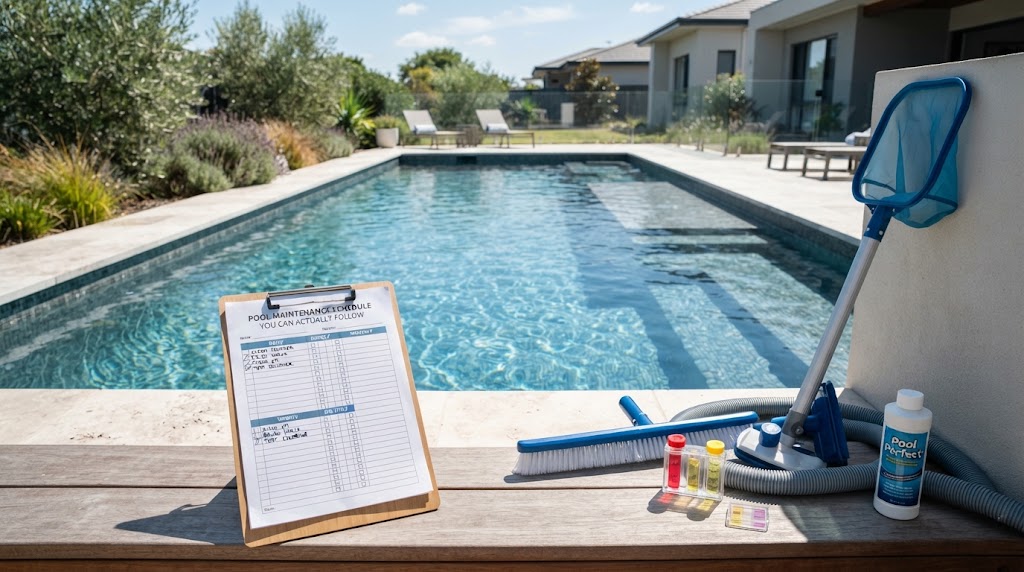
A Pool Maintenance Schedule You Can Actually Follow
A workable pool maintenance schedule has four layers: check water and equipment every day, clean the pool thoroughly each week, review less-frequent water-balance and equipment items monthly, and add extra checks after storms, heavy swimming, or a chemical problem. The CDC recommends testing free chlorine and pH at least twice daily—more often when many people use the pool. A weekly checklist does not replace those sanitizer checks.
This schedule is for a typical privately owned outdoor pool in the United States during its operating season. It works as a starting calendar for chlorine and saltwater-chlorinated pools, but your filter, pump, surface, sanitizer and local conditions may require different tasks. Follow the equipment manuals and product labels whenever they are more specific.
Pool maintenance schedule at a glance
| When | Checklist | What should trigger extra action? |
|---|---|---|
| Every day (pool in service) | ☐ Test free chlorine and pH at least twice; ☐ check clarity, water level and circulation; ☐ remove floating debris. | Heavy use, strong sun, storms, cloudy water, unexpected chlorine loss, unusual equipment sound. |
| Every week | ☐ Brush steps, walls and trouble spots; ☐ vacuum/clean floor; ☐ inspect and empty baskets safely; ☐ log filter pressure; ☐ review alkalinity if your testing plan calls for it. | Visible algae or deposits, weak return flow, clogged baskets, changing pressure or repeated chemistry drift. |
| Every month | ☐ Review stabilizer (CYA) and calcium hardness as applicable; ☐ inspect equipment and safety items; ☐ check waterline and maintenance log; ☐ service filter if indicated. | Large water replacement, high evaporation/refill, changing salt output, scaling, leaks, worn parts. |
| Seasonally / after events | ☐ Opening or closing checklist; ☐ reassess pump program; ☐ inspect after wind, rain, heavy swimming or freeze warnings. | Different climate, prolonged closure, debris load, damaged covers, weather alerts. |
Important: The cleaning intervals are a practical starting point, not universal rules. A heavily used backyard pool may need daily brushing or vacuuming; a lightly used covered pool may need less physical debris removal. Do not stretch the CDC’s chlorine and pH testing recommendation to fit a once-weekly cleaning calendar.
Daily pool checklist: water safety first
1. Test free chlorine and pH in the morning and later in the day
Use a reliable test kit according to its instructions, take a representative sample away from return jets, and write down the readings. The CDC favors a DPD test kit for chlorine and pH measurements; strips are convenient but generally less accurate. Do not assume that clear-looking water is adequately disinfected.
| Measurement | CDC residential-pool guidance | How to use the result |
|---|---|---|
| Free chlorine, pool without cyanuric acid (CYA) | At least 1 ppm | If below the minimum, keep swimmers out while you investigate and correct it according to the product label. |
| Free chlorine, pool using CYA or stabilized chlorine | At least 2 ppm | Check the sanitizer label and system guidance for operating limits; CYA changes how chlorine behaves. |
| pH | 7.0–7.8 | Recheck unexpected results; adjust only with a product suitable for your pool and according to its label. |
These are CDC public-health recommendations, not a one-size-fits-all dosing chart. Some products, surfaces, local rules and manufacturer instructions specify additional operating targets or upper limits. If you cannot confirm the water is within the applicable safe range, pause swimming and correct the issue before reopening.
2. Look at the pool before anyone swims
- Can you clearly see the deepest part and the main drain? Do not swim if cloudiness prevents a clear view.
- Is the water level where your skimmer and pump manufacturer expects it? A low level can let the system draw air.
- Are covers, drain fittings, ladders, barriers and gates visibly intact? A loose or damaged suction outlet is a stop-use issue.
- Is the pump circulating water without new leaks, strange grinding sounds, air surges or warning messages?
- Skim leaves and insects when present; remove debris before it sinks or blocks the skimmer.
If a drain cover is missing or broken, stop use and have a qualified professional assess it. Do not put hands or hair near suction fittings. Do not operate a pump that appears to be running dry.
Weekly pool maintenance checklist: clean, inspect, record
1. Skim, brush and vacuum where debris collects
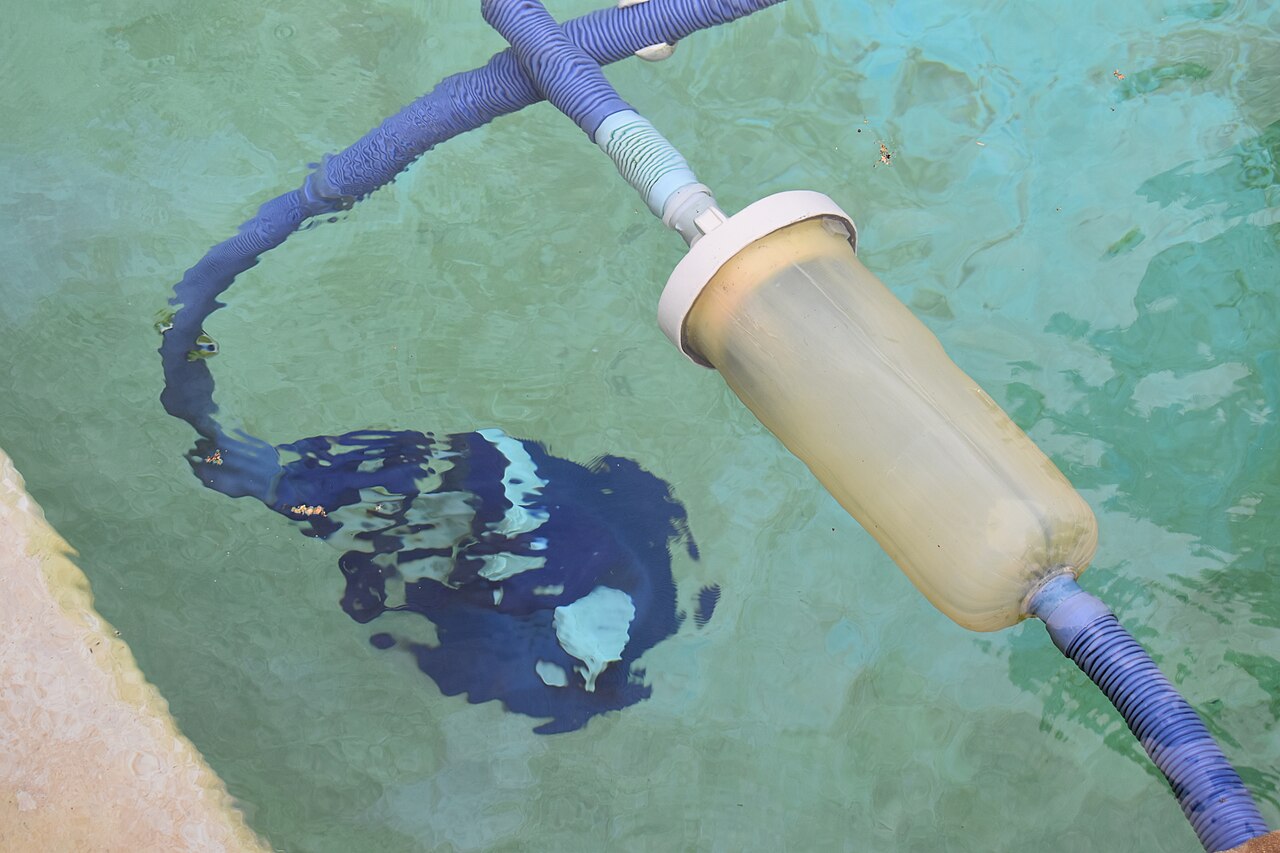
Brush the walls, floor edges, steps, corners and shaded areas with a brush approved for your pool surface. Vacuum settled dirt or run a compatible automatic cleaner according to its manual. A robotic cleaner can reduce floor-cleaning time, but it does not test water, maintain sanitizer or replace brushing every problem area.
2. Clear baskets without opening a pressurized system
Remove leaves from accessible skimmer baskets when the equipment and conditions make it safe. For the pump strainer basket, follow the specific pump manual: disable timers and automatic starts, turn off power, and relieve pressure before opening any housing. Never loosen a pump or filter lid under pressure. Refit covers correctly before restarting.
3. Check flow and compare filter pressure with its clean baseline
Record the filter pressure when the filter is clean and the pump is running in a documented, repeatable configuration. Compare later readings only at the same pump speed and valve setup. Rising pressure can suggest increasing resistance; unexpectedly low pressure can indicate a different circulation problem. A single universal “clean at X psi” rule is unreliable because filters and pumps vary. Use the filter manufacturer’s specified service threshold and procedure.
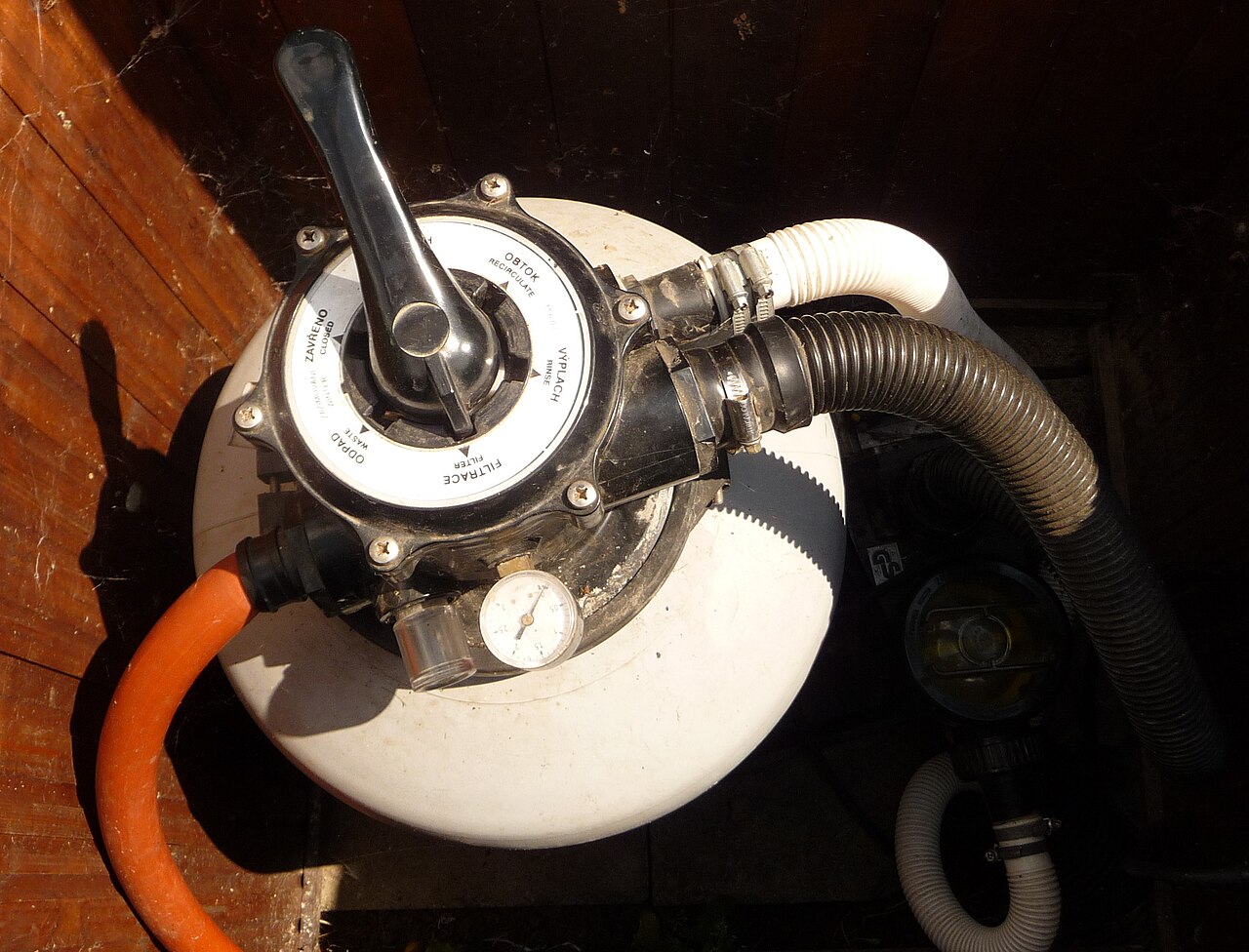
A filter housing can retain dangerous pressure. Pentair’s filter service instructions require switching the pump off, preventing automatic restart, opening the manual air relief, standing clear and confirming the pressure gauge reads zero before servicing. Follow your own equipment manual even if its steps differ.
4. Review chemistry trends rather than dosing by calendar
Weekly is a useful interval to review total alkalinity, chemical consumption and the previous seven days of chlorine/pH logs. Alkalinity helps explain recurring pH changes; it is not a substitute for daily sanitizer tests. Test additional parameters sooner if you have a new pool, changed fill water, a major adjustment or a manufacturer’s specific schedule. Add chemicals only after confirming what the water needs.
Monthly checklist: prevent slow-moving problems
- Stabilizer (cyanuric acid): Check where applicable, particularly if you use stabilized chlorine or have replaced substantial water. Follow sanitizer guidance; a fixed universal CYA target is not appropriate for every system.
- Calcium hardness: Test based on your pool surface, fill-water hardness and water-balance program. Hardness management differs between plaster and vinyl/fiberglass pools.
- Saltwater chlorine generators: Review displayed salt and output readings against the generator’s manual; inspect the cell if performance or alerts suggest a problem. Do not acid-clean a cell automatically every month.
- Filter: Inspect pressure/flow trends and service cartridge, sand or DE equipment only when the manual or observed condition calls for it. Never backwash a cartridge filter.
- Waterline and hardware: Remove deposits with surface-compatible tools. Check visible plumbing for leaks, inspect covers, ladders and gates, and note any deterioration.
- Logs and supplies: Check that test reagents are in date and properly stored, labels remain readable, and chemicals are locked in their original containers away from children.
For pools with a heater, automation controller, variable-speed pump or specialty finish, add the manufacturer’s inspection tasks to this monthly review. A professional service visit can be worthwhile when your records show a persistent unexplained trend.
A realistic seven-day pool care calendar
Choose one consistent weekly cleaning day, then spread short checks across the week. This example assumes the pool is operating and accessible. Free chlorine and pH testing still happens at least twice each day; the table highlights what else to do.
| Day | Additional action beyond twice-daily chlorine/pH testing |
|---|---|
| Monday | Inspect water level and equipment; skim if needed; review weekend swimming load. |
| Tuesday | Remove surface debris; check skimmer opening and visible return flow. |
| Wednesday | Brush steps, walls and corners; vacuum or run the approved cleaner. |
| Thursday | Check filter pressure at the recorded pump setting; note any noise or leaks. |
| Friday | Review test log and alkalinity trend; check supplies before weekend use. |
| Saturday | Before and after busy swimming, test more frequently as conditions warrant; remove debris. |
| Sunday | Empty baskets safely when needed; note tasks for the next week and any monthly items due. |
This arrangement avoids a long “pool day” while making the highest-risk water checks non-negotiable. Shift cleaning tasks to match wind, trees, rain and your household’s swim pattern.
Change the schedule when conditions change
| Situation | Extra checks or changes |
|---|---|
| After heavy rain or wind | Remove debris, check water level and circulation, test chlorine and pH promptly; inspect for storm damage. |
| After a large swim party | Test disinfectant and pH more often, clean baskets, brush/vacuum as needed and record unusual demand. |
| During a heat wave or heavy sun exposure | Pay closer attention to chlorine consumption, evaporation and pump operation; do not assume yesterday’s dose still works. |
| After significant drain/refill or new fill water | Recheck chemistry affected by the new water, including stabilizer and hardness where relevant. |
| Cloudy water, algae, unusual odor or low sanitizer | Stop treating it as routine maintenance. Restrict swimming, confirm test accuracy, diagnose the cause and correct it before use. |
| Winterized / closed pool | Follow your region-specific cover, freeze and equipment instructions; the in-season twice-daily water-testing schedule is for pools in operation. |
Keep a simple maintenance log
A notebook or spreadsheet is enough. Record the date and time, free chlorine (ppm), pH, water temperature if useful, stabilizer or alkalinity when tested, filter pressure at a known pump setting, visible condition, maintenance performed and the exact product/quantity added if any. Include the pool volume in US gallons and the equipment model on the first page.
| Date / time | Free chlorine | pH | Filter pressure + pump setting | Notes / action |
|---|---|---|---|---|
| ____ / AM | ____ ppm | ____ | ____ psi at ____ RPM | ________________ |
| ____ / PM | ____ ppm | ____ | (if checked) ____ | ________________ |
Example of why a log helps: if chlorine reads adequately in the morning but repeatedly falls below the relevant minimum by late afternoon, investigate sunlight exposure, stabilizer use, swimmer load, dosing system operation and test accuracy. Do not simply increase a guessed dose; identify the pattern and follow product guidance.
Safety rules that override any schedule
- Never mix pool chemicals with each other, even products with similar names. Keep them in original, labeled containers and follow label directions and storage separation.
- Do not use a generic chemical dosing table. Dose depends on measured levels, pool volume, product concentration, sanitizer system and manufacturer directions.
- Never open pressurized equipment. Disable automatic starts, shut off power and relieve pressure following the equipment manual before any service.
- Do not swim when sanitizer/pH readings are outside the applicable safe operating limits, water clarity is inadequate, or a suction outlet or electrical component is unsafe.
- Call a qualified pool professional for persistent low sanitizer, unexplained water loss, structural cracks, electrical faults, damaged suction fittings, recurring pump priming problems or pressure/flow anomalies you cannot diagnose safely.
A maintenance schedule is a reminder system, not a substitute for testing. Measure first, correct the specific problem, then retest before swimming.
Common schedule mistakes
- Testing only once a week: weekly cleaning is useful, but the CDC recommends checking free chlorine and pH at least twice daily while the pool is in service.
- Shocking on a fixed calendar: routine monthly shock is not universally necessary; base corrective treatment on measured water conditions and product instructions.
- Backwashing every Saturday: service interval depends on filter type, pressure trend and manufacturer requirements.
- Copying another pool’s pump runtime: the correct schedule depends on circulation needs, equipment performance, water quality and local conditions.
- Ignoring small leaks and suction noises: they can indicate an equipment or safety issue that should be investigated rather than deferred.
Quick questions about a pool maintenance schedule
How often should I test pool water?
The CDC recommends testing free chlorine and pH at least twice per day and more frequently when many people use the pool. Other measurements—such as alkalinity, calcium hardness and CYA—have different intervals based on your system and water changes.
Do I have to vacuum every week?
Weekly vacuuming is a useful starting point, but visible debris is the real trigger. A windy yard may need more frequent cleaning, while a covered, lightly used pool may need less. Brush areas that an automatic cleaner misses.
Should I clean my filter monthly?
Not necessarily. Follow the manufacturer’s instructions, your clean-filter pressure baseline and actual flow/pressure changes. Cartridge, sand and DE filters use different service methods.
Is a saltwater pool maintenance-free?
No. A saltwater chlorine generator produces sanitizer, but you still need to test free chlorine and pH, inspect circulation and filtration, clean the pool and maintain the generator according to its manual.
Sources and further reading
- CDC: Home Pool and Hot Tub Water Treatment and Testing — sanitizer/pH recommendations and test frequency (reviewed May 10, 2024).
- CDC: Guidelines for Keeping Your Pool Safe and Healthy — swimmer hygiene and safe operation.
- Pentair filter manual — example of manufacturer pressure-relief precautions; always consult your exact model’s manual.

.jpg)