How to Test Pool Water and Read the Results
To test pool water, collect a fresh sample from approximately 18 inches (45 cm) below the surface, away from return jets, and measure free chlorine and pH promptly with an appropriate DPD-based kit. Record the results, compare them with CDC guidance and your pool’s instructions, and verify unusual readings before making changes. Water clarity alone cannot confirm that a pool is safe.
This practical guide explains how to test pool water in a U.S. residential swimming pool, how to read the results, and what to do when a reading is confusing. Saltwater pools also need free-chlorine testing because salt chlorine generators produce chlorine.
The five-step pool water testing routine
- Choose an in-date kit that measures free chlorine and pH. DPD or FAS-DPD kits are more accurate than test strips for these measurements.
- Collect a representative sample about 18 inches (45 cm) below the surface. Stand securely on the deck and avoid skimmers, return jets and obvious stagnant spots.
- Follow the exact sample volume, reagent quantity and timing printed on your test kit.
- Record free chlorine and pH, plus other relevant readings such as total chlorine, cyanuric acid, alkalinity and calcium hardness.
- Compare readings with CDC recommendations, the chemical product label and equipment manuals. If a result is unsafe or uncertain, keep swimmers out until the issue is resolved.
The CDC recommends testing chlorine and pH at least twice daily in home pools, more often during heavy use. It recommends pH 7.0–7.8 and at least 1 ppm free chlorine for pools without cyanuric acid (CYA), or at least 2 ppm when CYA or stabilized chlorine products are used. These are minimums, not a complete product-specific dosing plan.
Choose the right pool test kit
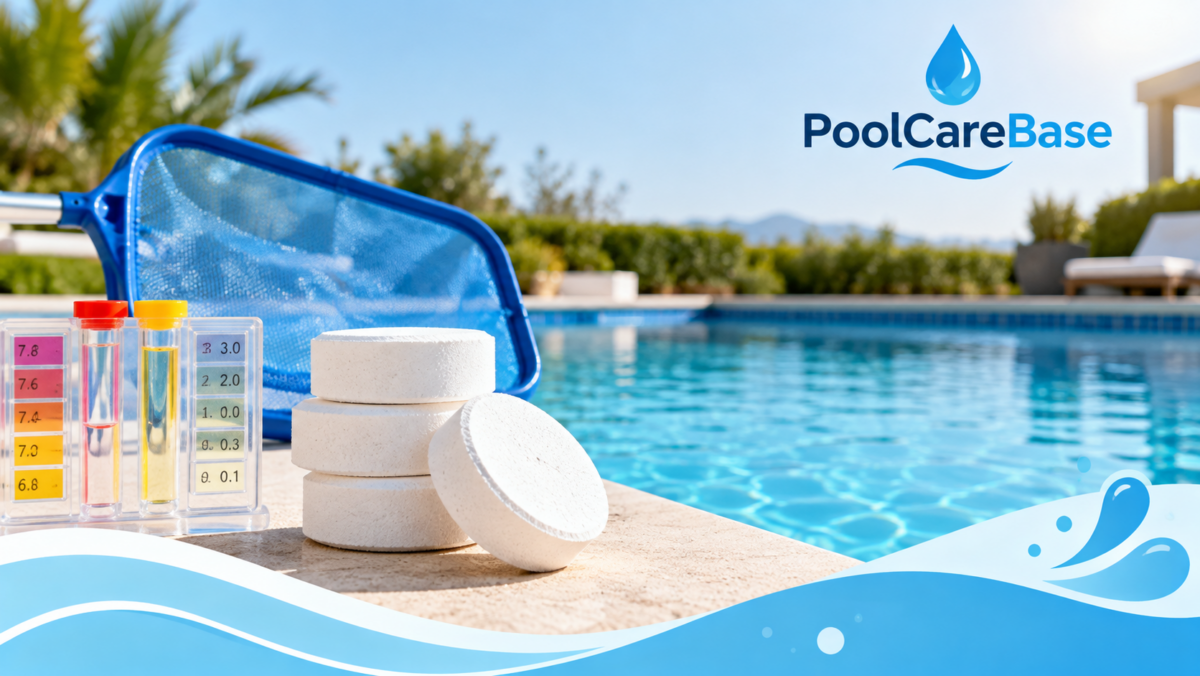
A DPD color comparator uses a pink color reaction to indicate free chlorine; a FAS-DPD titration kit counts drops to determine chlorine concentration. Many kits also measure pH using phenol red. Test strips offer convenient screening but the CDC says they are less accurate than DPD kits. A traditional OTO kit reports total chlorine rather than free chlorine and should not be used alone to judge disinfection.
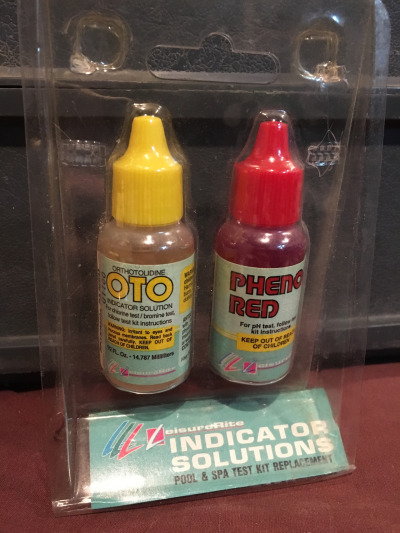
Before testing, check reagent expiration dates, rinse test chambers as instructed, and keep all testing materials away from children. Store reagents according to the manufacturer’s directions. The Taylor Technologies testing FAQ explains why old reagents, color-matching errors and residual reagents can produce misleading readings.
Collect a representative sample safely
Use a clean vessel or comparator tube to collect water from roughly elbow depth, about 18 inches (45 cm), rather than only skimming the surface. Avoid a return jet, a skimmer inlet, steps or recently treated water that has not circulated. This depth is specified in Taylor’s FAS-DPD test instructions.
- Stand on stable, dry decking; do not enter the pool solely to obtain a sample.
- Rinse the sampling vessel according to your kit’s instructions and avoid touching its interior.
- Take the sample away from concentrated chemical feed points and test promptly.
- Never return water containing test reagents to the pool; dispose of it as the reagent label directs.

Test readings should be recorded promptly.
Test free chlorine and total chlorine
Free chlorine (FC) is the sanitizer available to control germs. Total chlorine (TC) includes both free and combined chlorine. Combined chlorine (CC) = TC minus FC. A total-chlorine reading alone does not tell you how much available sanitizer remains.
DPD color-comparator method
Fill the correct chamber to its marked volume, add the specified DPD reagent, mix as directed and read the free-chlorine color at the correct time and in the recommended light. If your kit supports total chlorine, perform that separate step and calculate combined chlorine. Record readings in ppm. Use your own kit’s reagent quantities and color scale.
Understand the pH reading
Record the date and time with every measurement so you can spot patterns over several days.
For a color-based pH reading, compare the sample with the scale supplied by the manufacturer. The CDC recommends a range from 7.0 to 7.8. Confirm unexpected readings with a fresh sample and a working kit.