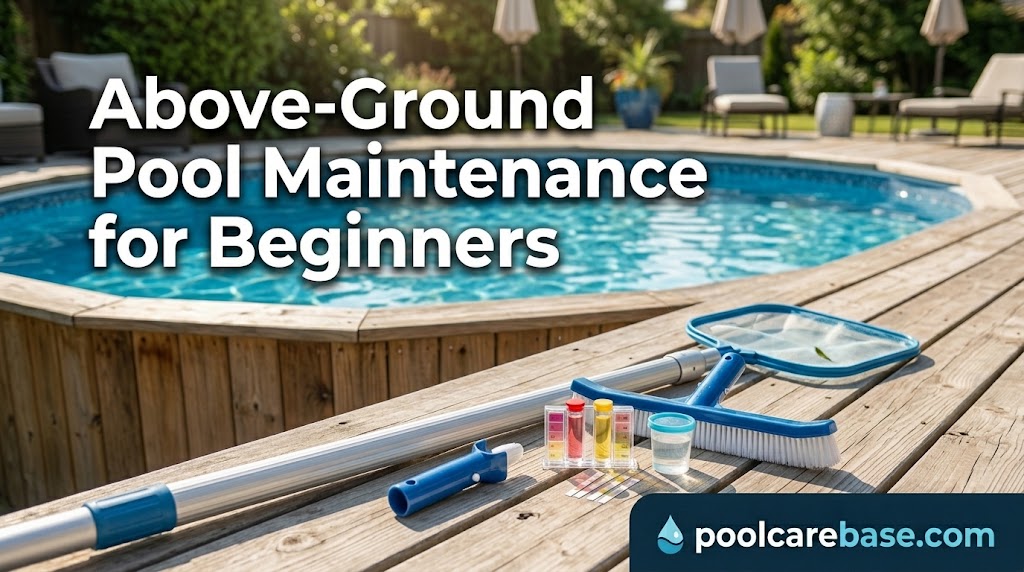
Above-Ground Pool Maintenance for Beginners
Above-ground pool maintenance comes down to five habits: test and balance the water, remove debris, run the correctly sized filter system, clean its filter, and inspect the liner, frame, hoses, and access ladder. Start with the routine below, then adjust it to your pool’s actual water capacity, filter manual, climate, and swimmer load. This guide is specifically for framed and soft-sided above-ground pools, not a generic in-ground pool checklist.
The beginner routine at a glance
| When | What to do | Why it matters |
|---|---|---|
| Before swimming / daily | Check water clarity and equipment; test free chlorine and pH; skim leaves; inspect ladder and barrier. | Catches water and safety problems before anyone enters. |
| At least twice daily when operating | Test free chlorine and pH; record readings, with extra tests during heavy use. | The CDC advises testing residential pool chlorine and pH at least twice a day. |
| Weekly, or sooner when dirty | Brush the liner gently; vacuum the floor; check cartridge or sand-filter condition; inspect hoses and fittings. | Removes material the filter may miss and helps maintain circulation. |
| After storms or heavy use | Remove debris, check water level, retest sanitizer and pH, and inspect power and hoses. | Rain, splash-out and high bather load can change conditions. |
| Monthly / seasonally | Inspect frame joints, supports, liner seams, ladder, ground, cover and equipment manual; plan opening or closing. | Small equipment issues can become expensive or unsafe. |
The frequencies for cleaning and equipment inspection are a practical starting schedule, not a substitute for your manufacturer’s maintenance intervals. CDC guidance for home pools recommends testing free chlorine and pH at least twice daily, and more often when many people swim.
1. Identify your pool type, capacity and filter before adding anything
Find your pool’s make and model, the manufacturer’s filled-water capacity in US gallons, and the pump/filter manual. Above-ground pools vary: small soft-sided pools may use a compact cartridge pump; larger frame pools may use a larger cartridge or sand-filter system. A saltwater chlorine generator still needs water testing, circulation and filter care.
- Water capacity: use the manufacturer’s stated capacity at the recommended fill line, not just the box’s outer dimensions. A 3,000-gallon pool holds about 11,356 liters; 1 US gallon equals about 3.785 liters.
- Filter: note cartridge type and replacement instructions, or sand-filter pressure baseline and backwash procedure. Never assume all filters are cleaned the same way.
- Flow: check the system flow rate, which can be lower than the pump’s advertised flow rate. Confirm the manufacturer-approved daily run schedule for your pool and pump.
- Waterline: keep the level within the skimmer or inlet’s manufacturer-specified range so the pump does not draw air or run dry.
- Power: use the electrical protection and placement required by the equipment manual and local electrical code; have a qualified electrician address damaged cords, tripping protection or unsafe wiring.
Example—not a run-time prescription: 3,000 gallons divided by a stated system flow of 1,000 gallons per hour equals three hours of theoretical circulation for one pool volume. Actual turnover depends on plumbing and filter resistance, and adequate filtration time may be longer. Use the equipment manual and observed clarity rather than treating this calculation as a universal timer setting.
2. Test and understand the water before making adjustments
For a chlorine-treated residential pool, measure free chlorine and pH first. According to the CDC, pool pH should be 7.0–7.8. Free chlorine should be at least 1 ppm, or at least 2 ppm when cyanuric acid (stabilizer) or stabilized chlorine is used. These are CDC minimums and pH guidance, not universal upper limits or dosing instructions; follow applicable local rules and the chemical/equipment labels. One ppm in water is approximately 1 mg/L.
A DPD liquid test kit is preferred by the CDC for more accurate chlorine and pH readings, although strips can be useful when used according to their directions. Check expiration dates and sample water away from a return jet at the depth specified by the kit. Record the result and time. Very high chlorine can sometimes bleach a test result and make it appear falsely low, so do not add more sanitizer blindly after a surprising reading.
- Test free chlorine and pH; record the values in a simple log.
- If a result is outside the relevant safe range, keep swimmers out while you identify the cause and correct it.
- Check total alkalinity and stabilizer (cyanuric acid) with a suitable kit when troubleshooting persistent pH or chlorine problems.
- Read the specific product label, confirm actual pool volume and chemical strength, and adjust one product at a time exactly as directed.
- Allow the required circulation and wait time from the label, retest, and allow swimming only when the water and equipment meet all relevant safety directions.
Never mix pool chemicals together or reuse a scoop/container contaminated by another chemical. Store them dry, separated, in original labeled containers and out of children’s reach. The CDC’s pool chemical safety guidance and EPA chemical safety alert explain why mixing and moisture exposure are dangerous.
3. Remove leaves and brush the liner without damaging it
Skim floating leaves, insects and grass before they sink. Use a soft, liner-safe brush along the walls, floor seams, steps and shaded spots. Vacuum settled dirt with a cleaner compatible with your liner and filtration system. Avoid abrasive pads, sharp vacuum heads or tools that can puncture vinyl. A cover can reduce incoming debris, but it is not a substitute for sanitizer or a compliant safety barrier.
For soft-sided pools, inspect the top ring or fabric walls as you clean. For metal-frame pools, look at leg alignment, support joints, ground settlement and corrosion. If a wall is bulging, leaning, leaking at a seam or moving unexpectedly, stop use and contact the pool manufacturer or qualified installer rather than trying to brace it while full.
4. Keep the pump and filter operating safely
Filtration removes particles; it does not replace chemical disinfection. Use your model’s recommended run-time and clean the filter when performance drops or the manual says it is due. For example, Intex’s 1,500 GPH cartridge pump page describes routine cartridge rinsing or replacement and identifies a cartridge type for that specific pump—not every above-ground filter.
Cartridge pump checklist
- Switch off and unplug the pump, isolate valves if applicable, and relieve pressure according to the exact manual before opening any housing.
- Inspect the cartridge for trapped dirt, tears or collapsed pleats. Rinse or replace it according to the manufacturer’s instructions; never substitute an incompatible cartridge.
- Check hose connections, O-rings and clamps for drips or air entry. Do not overtighten or alter pressurized parts.
- After reassembly, prime or purge trapped air using the model-specific procedure, then confirm normal return flow and no leaks.
Sand filter checklist
Record the clean-filter pressure after proper setup. Backwash and rinse only as directed by your sand-filter manual; not every high reading means the same problem. Never open a pressurized filter or change valve position while the pump is running unless the manufacturer explicitly instructs it. If a pump repeatedly loses prime, leaks near electrical components or trips protection, stop and have the issue inspected.
5. Inspect the above-ground structure and access points
Unlike many in-ground pools, an above-ground pool’s liner, frame and removable ladder are visible and can be affected by ground movement. Walk around the exterior weekly to look for damp spots, loose fittings, settling supports, corrosion, wrinkles that are worsening, and a stable, level waterline. Do not drain or relocate a pool without following its manual; an unsupported liner or frame may be damaged.
Drowning prevention is part of maintenance. The U.S. Consumer Product Safety Commission’s pool barrier guidance explains that above-ground pools need effective barriers, and ladders or steps should be secured, locked, removed or otherwise isolated to prevent unauthorized access. Follow local barrier codes, supervise swimmers actively, and never rely on a cover or removable ladder alone.
A realistic first-week setup
- Day 1: photograph the equipment model labels, read the pool and filter manuals, write down the filled-water capacity, and inspect the barrier and ladder.
- Day 2: start a dated free-chlorine/pH log; learn how your test kit works and identify your filter type.
- Day 3: skim and brush the pool; confirm normal return flow and inspect all hose joints.
- Day 4: check your filter’s cleaning instructions and note its clean operating condition.
- Day 5: inspect liner seams, supports, waterline and the area around the pool for leaks or settlement.
- Day 6: review how hot weather, rain and swimmers affected your readings; adjust testing and cleaning frequency as needed.
- Day 7: repeat the weekly cleaning and safety inspection; keep the log and manual where you can find them.
Keep testing free chlorine and pH at least twice daily during this week and throughout the swimming season. The seven-day plan adds one small learning task per day; it does not replace routine water checks.
Quick troubleshooting: what to check first
| Symptom | First checks | Stop / call a professional when |
|---|---|---|
| Cloudy water | Test free chlorine and pH; check filter flow and cartridge condition; brush and vacuum. | You cannot see the bottom clearly, water fails testing, or circulation cannot be restored safely. |
| Green tint or slippery walls | Check sanitizer reading and filtration; confirm the test is reliable. | The water is not safe for swimming; get a qualified pool service if the cause or treatment is uncertain. |
| Weak return flow | Check water level, basket and filter maintenance; inspect hoses for kinks or air leaks. | Pump runs dry, overheats, makes unusual noises, or electrical protection trips. |
| Water level drops quickly | Check hose connections and visible liner seams; compare evaporation with suspected leaks. | Frame movement, significant leaking, or electrical equipment is exposed to water. |
| Leaning frame or unstable ladder | Stop swimming and inspect from outside without loading the structure. | Any support has shifted, a wall bulges, or the ladder/barrier is not secure. |
Common beginner questions
How often should I test an above-ground pool?
The CDC recommends testing free chlorine and pH at least twice daily for home pools, and more frequently when the pool is heavily used. Test additional chemistry parameters as the product and pool system require.
Do I need chemicals if my pool has a filter?
Yes, if you use a chlorine-treated pool. A filter removes suspended debris; properly maintained disinfectant and pH help control germs. Saltwater systems also generate chlorine and still need testing.
How many hours should an above-ground pool pump run?
There is no reliable universal number. Check your pump’s system flow rate, pool capacity, manufacturer instructions, water clarity and conditions. Never assume that a theoretical single turnover guarantees safe water.
Can I leave an above-ground pool full all winter?
It depends on the pool’s construction, manufacturer instructions and local freezing conditions. Some seasonal soft-sided models are meant to be dismantled; other systems can be winterized in place. Follow the exact model manual rather than applying one closing method to every pool.
When should I keep swimmers out?
Keep swimmers out if free chlorine or pH is outside applicable safe limits, the bottom is not visible, the pump or suction system is unsafe, the ladder/barrier is compromised, or a liner/frame defect threatens stability. Seek professional help for chemical exposures, structural damage or electrical hazards.
Sources and editorial method
This guide synthesizes current public-health safety guidance and manufacturer-specific equipment information; it is not based on a claimed hands-on product test. Always prioritize your pool’s own manual, chemical product labels, local requirements and qualified professional advice.